
For nearly two decades, the goal was simple and universally understood: rank #1 on Google for your most important keywords, and the customers would follow. It was the single clearest measure of SEO success, and for good reason — the #1 position reliably captured the largest share of clicks for any given search.
That reliability has quietly broken down. A business can now rank #1 for its most important keyword and see meaningfully fewer customers finding them than it would have two or three years ago — through no fault of their SEO work at all.
This isn’t a reason to abandon SEO. It’s a reason to understand exactly what’s changed, and what else now needs to sit alongside it.
The Data That Explains What’s Happening
A few specific numbers explain this shift clearly:
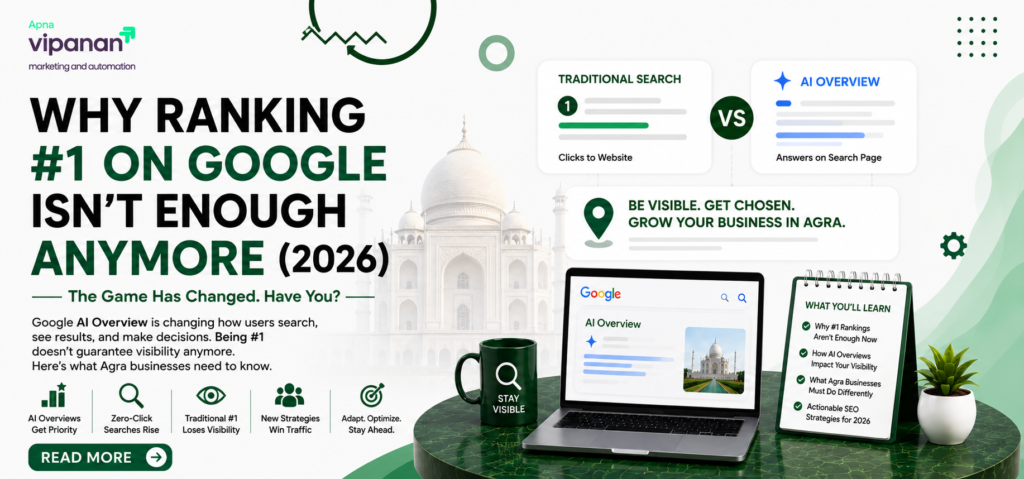
Zero-click searches now account for nearly 60% of all Google queries — meaning the majority of searches end with the user getting an answer directly on the results page, without visiting any website at all
Google’s AI Overview is triggered in roughly a quarter of all searches, a proportion that has been climbing steadily rather than leveling off
When an AI Overview specifically appears above a search result, position #1 organic rankings can see a 34.5% to 61% drop in click-through rate,
compared to the same ranking position when no AI Overview is present
Put plainly: the #1 position still exists, and still matters — but it no longer guarantees what it used to. An AI Overview sitting directly above your #1 result can answer the user’s question completely, leaving little reason for them to scroll further and click through to your site at all.
Why This Happened
Google’s core business has always depended on keeping users satisfied with their search experience. For most of Google’s history, that meant directing users efficiently to the best available webpage. Increasingly, especially for direct, factual, or explanatory questions, Google has found it can satisfy users
more efficiently by simply generating the answer itself, directly on the results page.
This isn’t a sudden or isolated change — it reflects a broader shift across search generally, including the rapid growth of conversational AI tools like ChatGPT and Perplexity, which skip traditional search results entirely in favor of direct, synthesized answers.
The common thread: across multiple platforms and formats, the answer is increasingly being generated and shown directly to the user, rather than the user being directed to click through and find it themselves.
Does This Mean SEO Is Dead?
No — and it’s worth being precise about why not, because this gets oversimplified often.
SEO still matters because:
- Not every search triggers an AI Overview. Roughly three-quarters of searches still don’t show one, meaning traditional ranking position remains the primary factor determining visibility for the majority of queries.
- AI Overviews still draw heavily from traditionally ranking content. Google’s AI Overview doesn’t generate its answers from nowhere — it pulls heavily from pages that already demonstrate strong search authority. Weak or poorly-ranking content is unlikely to be cited in an AI Overview either. In
a real sense, strong traditional SEO remains a prerequisite for AI Overview visibility, not an alternative to it. - Commercial and navigational searches behave differently than informational ones. Someone searching “[your business name] phone number” or “buy [specific product]” is far less likely to encounter an AI Overview than someone asking a general informational question — meaning SEO’s
traditional value remains largely intact for many high-intent commercial searches.
What’s actually changed isn’t that SEO stopped working — it’s that SEO alone is no longer sufficient to guarantee the visibility and traffic it used to.
What Needs to Sit Alongside SEO Now
This is where AEO (Answer Engine Optimization) becomes relevant — not as a replacement for SEO, but as the additional, specific work needed to also be one of the sources cited inside the AI Overview, rather than just ranking below it. The practical relationship looks like this:
SEO gets you:
Strong rankings in the traditional list of results
The foundation of search authority that AI Overviews draw from in the first place
AEO additionally gets you:
A genuine chance at being one of the 2-5 sources Google’s AI Overview cites directly Visibility that persists even when a user never scrolls down to the traditional results at all Roughly 80% of solid AEO work overlaps with good SEO practice already — clear, well-structured, genuinely useful content. The additional layer is mostly structural: direct-answer formatting in the opening of your content, specific schema markup (FAQ, HowTo), and a few additional considerations around how confidently Google’s systems can identify your business as a credible source on a given topic.
A Realistic Before-and-After Example
Imagine a coaching institute in Agra that has invested seriously in SEO for two years and genuinely ranks #1 for “best coaching institute Agra for SSC.” Two years ago: That #1 ranking reliably drove a strong, predictable stream of website visits and enquiries — the SEO investment paid off directly and visibly.
Today, without any additional AEO work: The same #1 ranking still exists. But for many related questions — “how to prepare for SSC CGL,” “is coaching necessary for SSC exams” — an AI Overview now appears above all organic results, including this #1 ranking, citing other (often larger, national, non-local)
sources. The institute’s traffic from these related, valuable searches has quietly declined, even though their core ranking position hasn’t moved at all.
With AEO work added: The institute restructures key content with direct-answer formatting and FAQ schema specifically addressing these related questions. Some of these queries now show the institute’s content cited inside the AI Overview itself — recovering visibility that pure ranking position alone
could no longer deliver.
This is a realistic pattern playing out across countless businesses and industries right now — strong SEO fundamentals that used to be sufficient on their own, now needing a specific additional layer to fully capture the visibility they once reliably produced.
What This Means Practically for Your Business
If you’ve invested in SEO and are seeing your rankings hold steady while traffic or enquiries have quietly softened, this shift is a genuinely plausible explanation worth investigating — rather than assuming your SEO work has somehow stopped being effective.
A practical next step: Test your most important related questions (not just your core keyword) directly in Google, in an incognito browser, and check specifically whether an AI Overview appears above your ranking — and if so, whether you’re one of the cited sources or not.
If you find AI Overviews appearing consistently above your strong rankings, with competitors or generic national content being cited instead of you, that’s a clear, specific, and addressable gap — not a sign that SEO itself has failed, but a sign that the next layer of work is now genuinely necessary
Frequently Asked Questions
Is SEO a waste of money now that AI Overviews exist? No. SEO remains the foundation that AI Overview visibility is built on top of — content that doesn’t rank well traditionally is unlikely to be cited in an AI Overview either. What’s changed is that SEO alone is no longer sufficient on its own to guarantee the visibility it used to.
Should I stop trying to rank #1 since clicks have dropped? No — ranking #1 still captures meaningfully more traffic than ranking #5 or #10 for the roughly three-quarters of searches that don’t trigger an AI Overview, and #1 rankings remain a prerequisite for AI Overview citation eligibility in many cases. The goal isn’t to abandon ranking; it’s to add AEO-specific work on top of it. How do I know if this is actually affecting my business specifically, or if it’s just a general trend? The clearest way to know is to directly test your own most important related search queries (not just your main keyword) and check whether AI Overviews are appearing above your rankings, and who gets cited when they do. This gives you specific, business-relevant evidence rather than relying on general industry trends alone.
Is this only relevant for big businesses, or does it affect small local businesses too? It affects businesses of every size, and in some respects, local businesses have a specific advantage in responding to it — large national competitors often lack hyper-local detail that an AI Overview favors for genuinely local queries, giving a well-optimized smaller business a real chance at citation that wouldn’t exist in a purely Traditional-ranking competition against bigger sites.
How quickly can a business realistically recover visibility lost to this shift? AEO-specific changes — direct-answer restructuring, schema implementation — can show measurable movement within 30-60 days, since Google’s own AI systems re-crawl and re-index content faster than many other ranking factors change. This makes it one of the faster areas of optimization available right now. Find Out Exactly Where You Stand
Most businesses in Agra have strong SEO fundamentals but have never specifically checked their AI Overview visibility.
ApnaVipanan’s free AEO audit tests your most important questions and shows you exactly where you’re being cited — and where you’re not.
+91-8077824007 contact@apnavipanan.com
[Get Your Free AEO Audit →]
Key Takeaways
Zero-click searches now make up nearly 60% of all Google queries; AI Overviews appear in roughly a quarter of searches and are climbing A #1 ranking can see a 34.5-61% drop in click-through rate when an AI Overview appears above it SEO isn’t dead — AI Overviews still draw heavily from content with strong traditional search authority What’s changed is that SEO alone is no longer sufficient; AEO is the additional, specific layer now required