
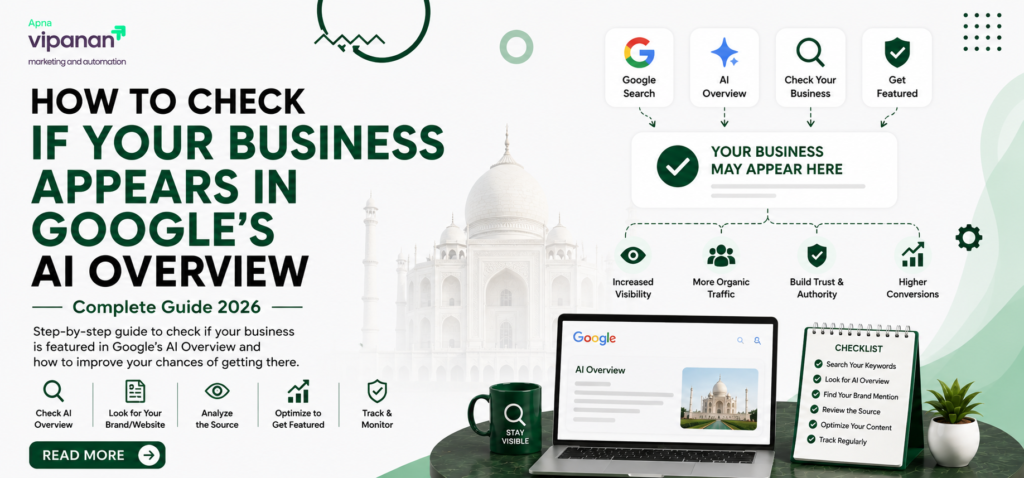
Here’s a question almost every business owner can answer instantly: “Where do I rank on Google for my main keyword?” Most people have checked this at some point, even informally. Now here’s a question almost nobody can answer: “Does Google’s AI Overview ever mention my business by name?”
This is a completely different, and increasingly important, question — and the good news is, checking it doesn’t require any paid tool or technical expertise.
This guide walks you through exactly how to do it yourself, in about 15 minutes, for free.
Want a professional version of this audit, tested across dozens of queries? [Get a Free AEO Audit →]
Why This Check Matters
Google’s AI Overview now appears in roughly a quarter of all searches, and it answers many of those queries directly — without the user ever scrolling down to the traditional list of links. If you’ve only ever checked your traditional ranking position, you genuinely don’t know whether you’re visible in this entire other layer of search that’s growing every quarter.
A business can rank #1 in traditional search and still be completely invisible inside the AI Overview that appears above it — and a smaller competitor could be the one actually cited inside that answer box instead.
Step 1 — List the Real Questions Your Customers Ask
Before testing anything, write down 10-15 actual questions a potential customer might type into Google related to your business — not your brand name, but the problem you solve or the decision they’re making. Examples by industry:
Coaching institute: “best coaching for NEET in Agra,” “how long does JEE preparation take,” “is online or offline coaching better for UPSC”
Real estate: “is Dayalbagh a good area to buy property in Agra,” “how does property registration work in UP,” “what documents do I need to buy a flat”
Solar company: “how much can I save with solar panels in UP,” “is there a government solar subsidy in Agra,” “how long do solar panels last”
Clinic/hospital: “when should I see a doctor for [symptom],” “best [specialist type] near me in Agra”
Hotel: “best time to visit Agra,” “how many days do I need to see the Taj Mahal” These question-style searches are far more likely to trigger an AI Overview than a simple business-name search, so they give you a realistic picture of your actual visibility.
Step 2 — Search Each Question on Google (in Incognito Mode)
Open an incognito or private browser window before searching. This matters because Google personalizes results based on your search history and location data tied to your account — searching in incognito gives you a cleaner, more representative view of what a typical searcher in your area would
actually see.
For location-specific queries, you can also use Google’s “search tools” to set a specific location if you want to simulate a search from a particular area —useful if you serve multiple parts of Agra or nearby districts.
Step 3 — Check Whether an AI Overview Appears For each question,
note: If not, who is? Note whether it’s a direct competitor, a generic national website, a directory/aggregator site, or simply nobody specific to your local market. Keep a simple running list — even a basic spreadsheet with the question, whether an AI Overview appeared, and who got cited, is enough to build a real picture.
Step 4 — Look for Patterns, Not Just Individual Results
After testing 10-15 questions, patterns usually emerge quickly. You might find, for example: AI Overviews appear consistently for “how to” and “what is” style questions, but rarely for very specific local searches
A particular competitor keeps getting cited across multiple unrelated questions — suggesting they have strong overall entity authority, not just one good page
Generic national websites or directories get cited far more often than any actual local business — suggesting nobody in your specific market has built the right content yet, which is itself useful information This pattern-level view is usually more useful than any single result, since it tells you where to focus your effort first.
Step 5 — Test Your Own Content Directly
Beyond customer-style questions, it’s also worth specifically searching the exact topics your own existing web pages and blog posts are about, to see whether your own content shows up as a citation source for queries it should reasonably be relevant to.
If you have a blog post specifically titled and structured around a question — and that exact question still doesn’t trigger your site as a citation — that’s a clear, specific signal that the content needs restructuring (see the “what to do next” section below).
What If You Don’t See an AI Overview at All for Your Test Queries?
This is actually common and not necessarily a problem with your testing — AI Overviews don’t appear for every single search. They tend to show up more for genuinely informational, question-based, or comparison-style queries, and less often for narrow, highly specific local commercial searches (like “[your
exact business name] Agra”).
If none of your test questions triggered an AI Overview, try broadening a few of them slightly into more general informational territory — “what should I look for in a coaching institute” rather than “[your institute name] reviews,” for example — since these broader, more common questions are more likely to surface the feature.
What to Do If You’re Not Currently Cited
If you’ve tested several relevant questions and your business doesn’t appear in any AI Overview, while a competitor (or nobody specific to your area) does, here’s the realistic path forward:
- Restructure your existing content so the opening 150-200 words of your most relevant pages directly and completely answer the specific question, rather than building up to it
- Add FAQ sections with proper schema markup addressing these exact customer questions in clear, extractable language
- Strengthen entity consistency — make sure your business information is described identically across your website, Google Business Profile, and any directory listings
- Re-test after 30-60 days — since AEO-specific changes often show measurable movement within this window, faster than most other forms of search optimization
A Realistic Example of What This Test Reveals
Imagine a coaching institute in Agra runs through this exact process and tests 12 student/parent questions. Here’s a realistic pattern they might find:

Frequently Asked Questions
Is this test something I can really do myself for free? Yes — every step above only requires a web browser and about 15 minutes. No paid tools, accounts, or technical setup are required for this basic manual version of the check.
How often should I re-run this test? Roughly every 30-60 days makes sense, since AI Overview citations can change meaningfully on that timescale as Google re-crawls and re-indexes content, and as you make changes to your own pages.
Why does my business appear in regular Google search but not in the AI Overview for the same topic? Ranking in traditional search and being cited in an AI Overview are related but separate outcomes. Your content might rank reasonably well overall while still lacking the specific direct-answer structure or schema markup that makes it easy for Google’s AI system to extract and cite cleanly.
Does this test work the same way for ChatGPT or other AI tools? The same basic principle — testing real customer questions and noting what gets mentioned — applies to ChatGPT, Perplexity, and similar tools. However, those are separate, third-party AI models (this falls under GEO rather than AEO), and testing them works slightly differently since they don’t show the same kind of “sources” citation format Google’s AI Overview does.
What’s the difference between not appearing in an AI Overview and not having an AI Overview appear at all? These are two different situations worth distinguishing. Sometimes no AI Overview appears for a search at all — meaning there’s nothing to be cited in, for that specific query. Other times, an AI Overview clearly appears but cites different sources, meaning there was an opportunity and your business wasn’t part of it. The second case is the one worth focused attention.
Let Us Run This Audit Professionally for You
The manual process above gives you a real, honest starting picture. For a more thorough audit — testing dozens of relevant queries, tracking patterns systematically, and building a specific action plan based on the results — ApnaVipanan offers this as part of our AEO service. +91-8077824007 contact@apnavipanan.com
[Get Your Free Professional AEO Audit →]
Key Takeaways
Ranking well in traditional Google search and being cited in an AI Overview are two separate, related outcomes — you need to check both
Test real customer questions (not your brand name) in incognito mode to get a representative view
Look for patterns across multiple queries, not just single results — patterns reveal whether you’re losing to a specific competitor or to generic, nonlocal content
AI Overviews appear more often for informational, question-based searches than for narrow commercial ones
Re-test every 30-60 days, since AEO changes can show movement within that window