
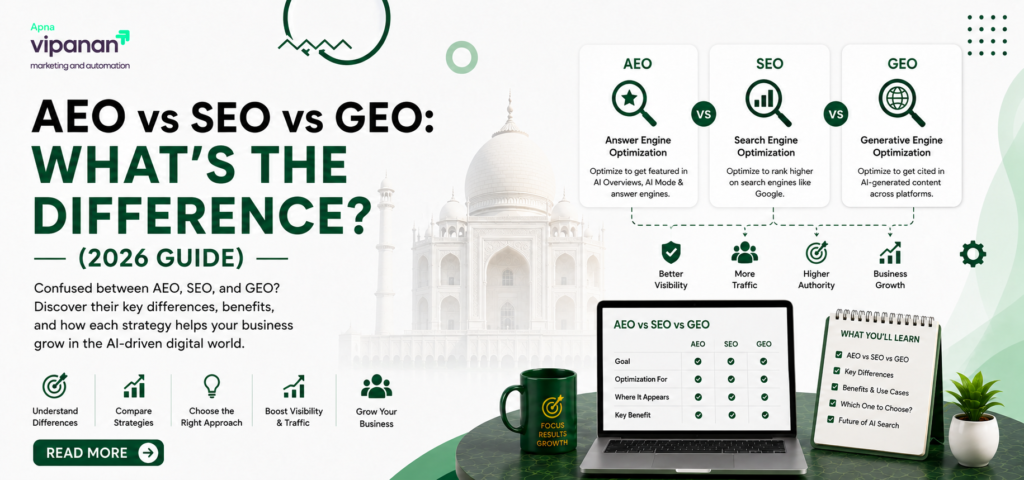
Three acronyms. Three different things to optimize for. And almost every business owner we talk to in Agra has heard at least one of these terms and assumed it means the same thing as the others. It doesn’t. And the difference matters more than it might seem — because each one requires a slightly different strategy, gets measured differently, and wins your business visibility in a different place. This guide breaks down exactly what separates SEO, AEO, and GEO — in plain language, with real examples — so you know exactly what you’re investing in and why.
Not sure which one your business needs first? [Get a Free Visibility Audit →]
The Short Answer
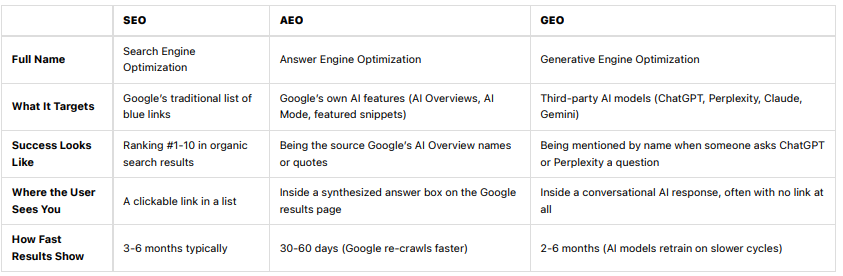
If you only remember one thing from this guide, remember this: SEO gets you ranked. AEO gets you featured inside Google’s own answer. GEO gets
you mentioned by name inside someone else’s AI tool. All three matter. None of them replace the other two.
SEO: The One You Already Know
Search Engine Optimization is the original discipline — optimizing your website so it ranks higher in Google’s traditional results page, the list of blue links with titles and descriptions. A simple example: Someone searches “best coaching institute in Agra for NEET.” Good SEO means your coaching institute’s website appears on page one — ideally in the top 3 positions — among the ten or so organic links Google shows.
What SEO involves:
Keyword research and targeting
On-page optimization (titles, headings, content structure)
Technical SEO (page speed, mobile-friendliness, crawlability)
Backlinks and domain authority
Consistent, quality content publishing over time
SEO is still the foundation everything else builds on. Even AEO and GEO depend heavily on the same underlying signals — clear, well-structured, authoritative content. But here’s the catch: SEO alone is becoming less sufficient on its own, because of what’s happening at the top of the search
results page itself.
AEO: Getting Featured Inside Google’s Own AI Answer
This is where things have changed dramatically in the last two years. When you search something on Google today, you’ll often see a synthesized answer box — Google’s AI Overview — appearing above all the traditional blue links, directly answering your question and citing 2-5 sources by name. Answer Engine Optimization is the practice of structuring your content so that your business is one of those cited sources — not just ranked below the AI Overview, but featured inside it. The numbers that make this urgent: Zero-click searches — where the user gets their answer without clicking any website — now account for nearly 60% of all Google queries. Google’s AI Overview itself is trigggered in roughly a quarter of all searches, and that share keeps climbing. Perhaps most strikingly,
position #1 organic rankings can see a 34.5% to 61% drop in click-through rate when an AI Overview appears above them. Read that last statistic again. You could rank #1 on Google — the exact result every SEO campaign aims for — and still see significantly less traffic than you would have two years ago, simply because Google’s own AI Overview is answering the question before anyone scrolls down to click your link.
What AEO involves:
Restructuring content so the first 150-200 words directly and completely answer the core question
FAQ schema, HowTo schema, and Speakable schema markup Targeting featured snippets and “People Also Ask” boxes specifically Entity clarity — making sure Google clearly understands who you are and what you offer AEO shares the vast majority of its foundation with SEO. If your SEO content is already clear, well-structured, and genuinely answers questions, you’re most of the way to good AEO already. The additional layer is mostly structural — direct-answer formatting and specific schema types.
GEO: Getting Mentioned by Name in ChatGPT, Perplexity, and Beyond This is the newest and most different of the three. Generative Engine Optimization targets visibility inside third-party AI tools — ChatGPT, Perplexity, Claude, Google’s Gemini (as a standalone conversational tool, distinct from AI Overviews built into search), and similar platforms.
A simple example: Someone doesn’t search Google at all. Instead, they open ChatGPT and type: “I need to install solar panels in Agra — which company should I consider?” ChatGPT doesn’t show a list of links. It generates one direct, conversational answer — naming two or three specific businesses by name.
GEO is the work that determines whether your business is one of the names ChatGPT mentions — or whether your competitor is mentioned instead, while you remain completely invisible to that entire conversation.
What makes GEO meaningfully different from AEO:
AEO targets Google’s own AI features, which re-crawl and update relatively quickly (results in 30-60 days)
GEO targets external AI models that retrain on much slower, less predictable cycles (results typically take 2-6 months)
GEO places heavier weight on third-party validation — mentions on platforms like Reddit, review sites, and industry directories — since these external
AI models cross-reference your entire digital footprint, not just your own website
AEO is reasonably measurable through Google Search Console; GEO requires manually testing prompts across multiple AI platforms, since there’s no equivalent official reporting tool yet
Why You Genuinely Need All Three — Not Just One
It’s tempting to think of these as competing options where you pick the “best” one. They’re not competing — they’re answering three different questions a customer might be asking, through three different channels:
- A customer Googling directly → needs your SEO to bring them to your site
- A customer who sees an AI Overview before any links → needs your AEO to be the source that overview cites
- A customer asking ChatGPT instead of Google entirely → needs your GEO to be the name ChatGPT mentions
A business that only invests in SEO is increasingly losing visibility to the second and third paths — even while their traditional rankings stay strong. A business that jumps straight to GEO while ignoring SEO fundamentals is building on a weak foundation, since GEO still depends heavily on the same content quality signals SEO has always rewarded.
The practical reality for most businesses, especially smaller local ones: SEO and AEO share about 80% of the same underlying work, so they should
be pursued together as one integrated effort. GEO requires some additional, distinct work — particularly around third-party authority building — but doesn’t require an entirely separate content strategy from scratch.
A Realistic Local Example
Imagine a real estate agency in Agra with these three scenarios happening simultaneously, all in the same week:
Scenario 1 (SEO): A buyer searches “real estate agent in Dayalbagh Agra” on Google. With solid SEO, the agency’s website appears on page one.
Scenario 2 (AEO): A different buyer searches “is Dayalbagh a good area to buy property in Agra.” Google triggers an AI Overview answering the question
directly. With good AEO, the agency’s locality guide is one of the sources that overview cites — putting the agency’s name directly inside that answer box,
even though the buyer never clicked through to a traditional search result.
Scenario 3 (GEO): A third buyer skips Google altogether and asks ChatGPT: “Who’s a good real estate agent in Agra for buying near Dayalbagh?” With
GEO work in place, the agency’s name comes up in ChatGPT’s conversational answer — visibility the agency would have had zero chance at without specific GEO-focused content and third-party presence.
Three different searches. Three different channels. The same underlying business needs visibility in all three to avoid losing customers it would have easily reached just a few years ago through SEO alone.
Which One Should You Start With?
If you’re starting from zero across all three, here’s a sensible sequence for most local businesses:
- SEO first, if you don’t already have a solid foundation — there’s limited value in AEO or GEO work on top of a website with weak content or technical
issues - AEO second, layered onto your SEO work — since it shares most of the same foundation and shows results faster (30-60 days)
- GEO third, once your content foundation is solid — building the additional third-party authority signals AI models specifically weighIf you already have decent SEO in place, you can realistically start AEO and GEO work in parallel, since a meaningful share of the work overlaps.
- Frequently Asked Questions
Is GEO the same thing as AEO? They’re closely related but distinct. We treat AEO as specifically targeting Google’s own AI features (AI Overviews, AI
Mode, featured snippets), while GEO targets third-party AI models like ChatGPT, Perplexity, and Claude. Some sources in the industry use the terms
interchangeably, but keeping them separate makes the strategy and measurement clearer.
Do I need to hire three different agencies for SEO, AEO, and GEO? No. Because the underlying work overlaps so heavily, especially between SEO and
AEO, a single agency that genuinely understands all three can integrate them into one strategy rather than running three disconnected efforts.
Which one is most important for a small business in Agra right now? Given that almost no business or agency in Agra has started AEO or GEO work
yet, both represent a genuine first-mover opportunity with very low competition. If your SEO foundation is already reasonably solid, AEO is typically the
fastest visible win since Google’s own systems update faster than third-party AI models retrain.
How do I measure success in each of these three areas? SEO is measured through traditional rank tracking and organic traffic in Google Search
Console. AEO is measured by testing whether your content appears inside AI Overviews and featured snippets for target queries — increasingly trackable
through Search Console’s own reporting as well. GEO is currently measured manually, by testing relevant prompts across ChatGPT, Perplexity, and similar
platforms and recording whether and how your business is mentioned.
Will SEO become irrelevant because of AEO and GEO? No. All three substantially share the same foundation: clear, well-structured, genuinely useful
content. SEO remains the base that AEO and GEO build on top of — none of these disciplines work well in isolation from solid underlying content and
technical fundamentals.
Find Out Where You Stand Across All Three
Most businesses in Agra have never been evaluated on AEO or GEO visibility at all — only traditional Google rankings. ApnaVipanan offers a free audit that checks where you stand across all three: your current SEO rankings, your AI Overview visibility, and whether AI tools like ChatGPT currently know your
business exists. +91-8077824007 contact@apnavipanan.com
[Get Your Free SEO + AEO + GEO Visibility Audit →]
Key Takeaways
SEO = ranking in Google’s traditional blue links
AEO = being featured inside Google’s own AI Overviews, AI Mode, and featured snippets
GEO = being mentioned by name inside third-party AI tools like ChatGPT and Perplexity
Zero-click searches now make up nearly 60% of all Google queries — AEO is no longer optional even for businesses with strong SEO
All three share significant underlying foundation, but each requires some distinct, specific work
For most local businesses: build SEO first, layer AEO on top (fastest results), then build GEO for third-party AI visibilit