
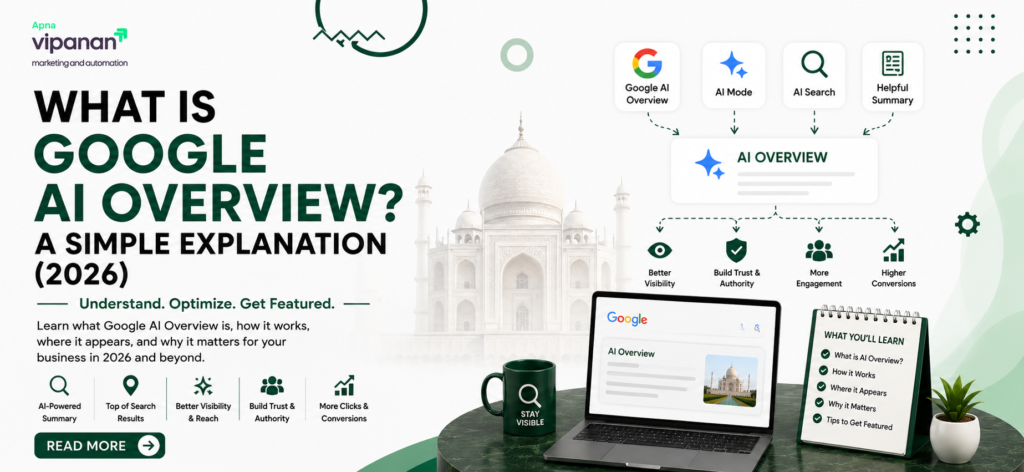
If you’ve searched almost anything on Google recently, you’ve probably noticed it: a box at the top of the results page, before any of the usual blue links, giving you a direct written answer to your question — sometimes with a few small source links underneath it.
That’s Google’s AI Overview — and understanding what it is, and how it decides what to show, matters more than most people realize, whether you’re a curious searcher or a business owner trying to stay visible.
This guide explains exactly what it is, how it works, and what it means for how people find businesses like yours.
What Is Google AI Overview, Exactly?
Google AI Overview is a feature built directly into Google Search that uses artificial intelligence to generate a written summary answering your search query — directly on the results page, without requiring you to click through to any website. A simple example: Search “how long does it take to recover from a root canal” and instead of just showing you ten links to click through, Google may show a box at the top with a written paragraph or two directly answering the question, often pulling and citing information from 2-5 different websites.
The key shift here: Google used to be a directory — it pointed you toward the websites that had your answer. Increasingly, for many queries, Google has become the answer itself — generating the response directly, with the original websites reduced to small citations underneath.
How Common Is This Now?
This isn’t a rare or experimental feature anymore — it’s become a significant part of how Google search works:
Google’s AI Overview is now triggered in roughly a quarter of all search queries, and that proportion has been steadily climbing
Zero-click searches — searches where the user gets their answer without clicking any website at all — now account for nearly 60% of all Google queries
For searches where an AI Overview does appear, studies show organic position #1 results can see a 34.5% to 61% drop in click-through rate compared to when no AI Overview is present That last point is worth sitting with for a moment. The traditional goal of SEO — getting to position #1 — used to more or less guarantee you the most clicks
for that search term. That’s no longer reliably true. If an AI Overview appears above your #1 ranking and answers the question directly, a large share of searchers simply read the answer and never scroll down to click anything at all.
How Does Google Decide What to Show in an AI Overview?
Google doesn’t write these answers from scratch out of nowhere — it generates them based on content that already exists on the web, generally drawing heavily from pages that already rank well in traditional search. A few key factors influence whether your content gets pulled into an AI Overview:
- Clear, Direct Content Structure
Pages that directly and completely answer a specific question — ideally within the first few sentences or paragraphs — are far more likely to be extracted and quoted than pages that build up to the answer slowly. - Structured Data and Schema Markup
FAQ schema, HowTo schema, and similar structured data help Google’s systems clearly identify question-and-answer content, making it easier to extract accurately. - Existing Search Authority
Content that already ranks well in traditional Google search remains one of the strongest predictors of being included in an AI Overview — these aren’t two completely separate systems; the AI Overview heavily draws from the same pool of high-quality, well-ranking content. - Factual Specificity
Vague, marketing-style language is less likely to be quoted than content with specific facts, numbers, and concrete details that can be lifted cleanly into a summary
AI Overview vs Featured Snippet: Aren’t These the Same Thing?
This is a common point of confusion, and the two are related but not identical.
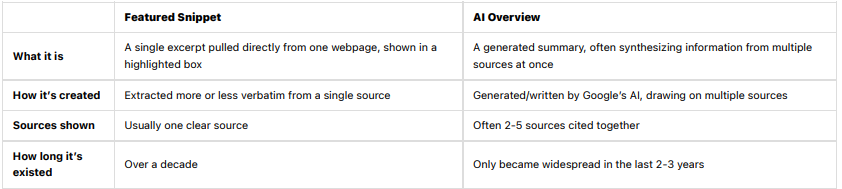
Both reduce the need for a user to click through to a website, and both reward similarly structured, direct-answer content — which is why strategies to win either one (often grouped under “AEO,” or Answer Engine Optimization) tend to overlap heavily.
What This Means If You Run a Business
If a meaningful share of your potential customers’ searches are now being answered directly inside an AI Overview, without anyone clicking through to a website — including yours — there are really only two possible outcomes:
Outcome 1: Your business isn’t part of that answer at all. The searcher gets their question answered, never learns your business exists, and never visits your website.
Outcome 2: Your business is one of the sources cited inside that AI Overview. The searcher sees your business name directly inside Google’s answer — building awareness and trust, even if they don’t click through immediately. Neither outcome involves a traditional click in the way SEO has always been measured. But one of them puts your business in front of the customer, and the other doesn’t.
This is the entire premise behind AEO (Answer Engine Optimization) — not abandoning traditional SEO, but adding the specific structural work that gives your content a real chance of being one of the sources Google’s AI Overview pulls from.
A Realistic Local Example
Imagine someone in Agra searches: “is solar panel installation worth it in UP.” Without AEO work: Google’s AI Overview answers the question generally, citing national solar information sites or larger companies outside Agra. A local solar installer in Agra is completely absent from this answer — even if their website technically exists and even ranks reasonably on page one further down.
With AEO work: The local installer has published clear, well-structured content specifically answering this exact question, with real UP-specific subsidy information and FAQ schema in place. Their content becomes one of the sources cited in that AI Overview — putting their business name directly in front of
a potential customer who may never have scrolled past the answer box at all. This is a realistic, achievable shift specifically because so few businesses — especially smaller local ones — have done this structural work yet.
Is This Trend Going to Slow Down?
Based on current data, the opposite seems true. The proportion of searches triggering an AI Overview has been climbing steadily, not plateauing, and industry analysts widely expect traditional, click-based search volume to continue declining as a share of total search activity as these AI-driven formats expand further.
This makes the current moment — when most local businesses, especially outside major metro markets, still have essentially zero AEO presence — a genuine window of opportunity rather than something to wait out.
Frequently Asked Questions
Does Google AI Overview replace traditional search results? Not entirely — traditional organic results still appear below the AI Overview for most searches. But the AI Overview’s position at the very top of the page, combined with its tendency to fully answer the question, significantly reduces how often users continue scrolling to click a traditional link.
Can I see whether my business currently appears in AI Overviews? Yes — you can manually test this by searching the exact questions your customers would ask, related to your business and location, and checking whether an AI Overview appears and which sources it cites. There’s no dedicated, official
Google tool for this specifically yet, though Search Console is beginning to surface some related data.
Does having an AI Overview appear above my website hurt my business? It depends entirely on whether you’re one of the cited sources. If you are, your visibility is generally strengthened — your business name appears directly inside the answer, even without a click. If you’re not cited and a competitor is, you’re at a real disadvantage compared to before AI Overviews existed.
Is optimizing for AI Overview the same as traditional SEO? They share a great deal of the same foundation — clear, well-structured, authoritative content. But AEO (Answer Engine Optimization) specifically requires some additional structural work, like direct-answer formatting in the opening
paragraphs and specific schema types, that general SEO work doesn’t always include.
Will this affect every type of search, or just certain topics? AI Overviews appear more frequently for informational and question-based searches than for very specific commercial or navigational searches (like searching a specific business’s name directly). Categories like health, how-to information,
comparisons, and general advice tend to trigger AI Overviews especially often. Find Out If Your Business Is Part of Google’s AI Answers Most businesses in Agra have never checked whether they currently appear inside an AI Overview for the questions their own customers are asking.
ApnaVipanan offers a free audit testing exactly that. +91-8077824007 contact@apnavipanan.com
[Get Your Free AEO Audit →]
Key Takeaways
Google’s AI Overview generates a direct written answer at the top of search results, often without requiring a click to any website
It now appears in roughly a quarter of all searches, and zero-click searches overall make up nearly 60% of all Google queries
Position #1 organic rankings can see a 34.5-61% drop in click-through rate when an AI Overview appears above them
AI Overviews favor clear, direct-answer content, structured data/schema, and content that already has strong search authority
This trend is growing, not slowing down — making now the right time for businesses, especially local ones, to address AEO